
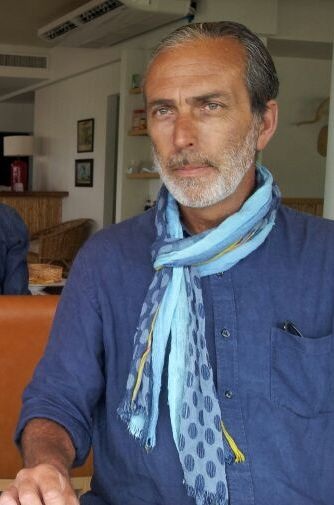
about
After working more than 10 years with the Grusenmeyer gallery responsible for African Art , Joaquin Pecci opened his own gallery in June 2007 specializing in African and Himalayan tribal art. This Gallery located at the Sablon holds regular themed exhibitions illustrated by catalogues and participates in major events related to non-European art, such as “Le Parcours des Mondes” in Paris, “BRUNEAF” in Brussels and the San Francisco Tribal & Textile Arts Show.
For the 10th edition of “Le Parcours des Mondes” 2011, Joaquin Pecci is preparing a major exhibition entitled “Sacrifice: Blood and Meaning” where patinas exhibit themselves as syntaxes of an invisible world forging the link of “what makes sacred” the objects of worship of the different ethnic groups represented.
- Those are the same shamanic cultures of the Himalayas that first awakened your passion?
- Yes. After studying art history in Montevideo, I travelled for 15 years in Asia. I was fascinated by the tribal cultures of North-eastern India and Nepal. Those people living on the Roof of the world were not known enough according to me. Sharing this adventure with a wide public has been really exciting.
- How did you move from Asia to Africa?
- I was specialized in tribal art not in classical Asian art. The transition has been even more natural when I moved to Belgium where African art is everywhere, of course. But the real click was the encounter in March 1986 with a book about the extraordinary New York exhibition, “Primitivism in 20th Century Art.” In the MOMA, William Rubin had had the idea to confront the works of Picasso, Derain, Matisse and Gauguin with primitive African and Oceanic art. The influence of the later, on the art of the 20th century was astonishing. This was THE revelation for me.
- Your gallery has the characteristic not to focus exclusively on central Africa: RDC.
- Absolutely. I am very interested in West Africa, and Cameroon. This is a trend: Belgian dealers confine themselves to the art of the Congo, even if it is a region where the diversity and richness of the objects are unique, do not forget the art of the Dogon which spreads over a much longer period of time.
- Could you be more explicit?
- A dealer can find central African pieces dating between half of the 19th century until the first third of the 20th century. In Mali, one can fall on works dating from the 12th or the 13th century! This country is very dry. The conservation of objects, masks, and carvings is ideal, a bit like in Egypt. A tribal art that can have more than 500 years is fascinating to me, especially as the Dogon were very great sculptors.
- You are known for innovative exhibitions as the original “Crossroads” in San Francisco or the “Printemps des Minimes” in Brussels.
- I still develop my interest in organizing exhibitions in my gallery as well as extramuros projects. The latest is the creation of “Tribal Art Society”, which includes 15 international merchants, all highly skilled in different areas, and will present on-line every 1st of the month, fifty objects, discoveries and new acquisitions. The aim of this project is double: give the possibility to people who no longer travel regularly to galleries to continue to feed their passion and be assured of purchasing authentic vetted objects. I must say that the time of the dealer waiting for the collectors without stepping out of his gallery is OVER. We must move on with our time!
Source : « Big Book », BRUNEAF 2011
